In a recent LinkedIn discussion, I highlighted a critical flaw in how teams are currently adopting AI: Personalization is the secret enemy of consistency.
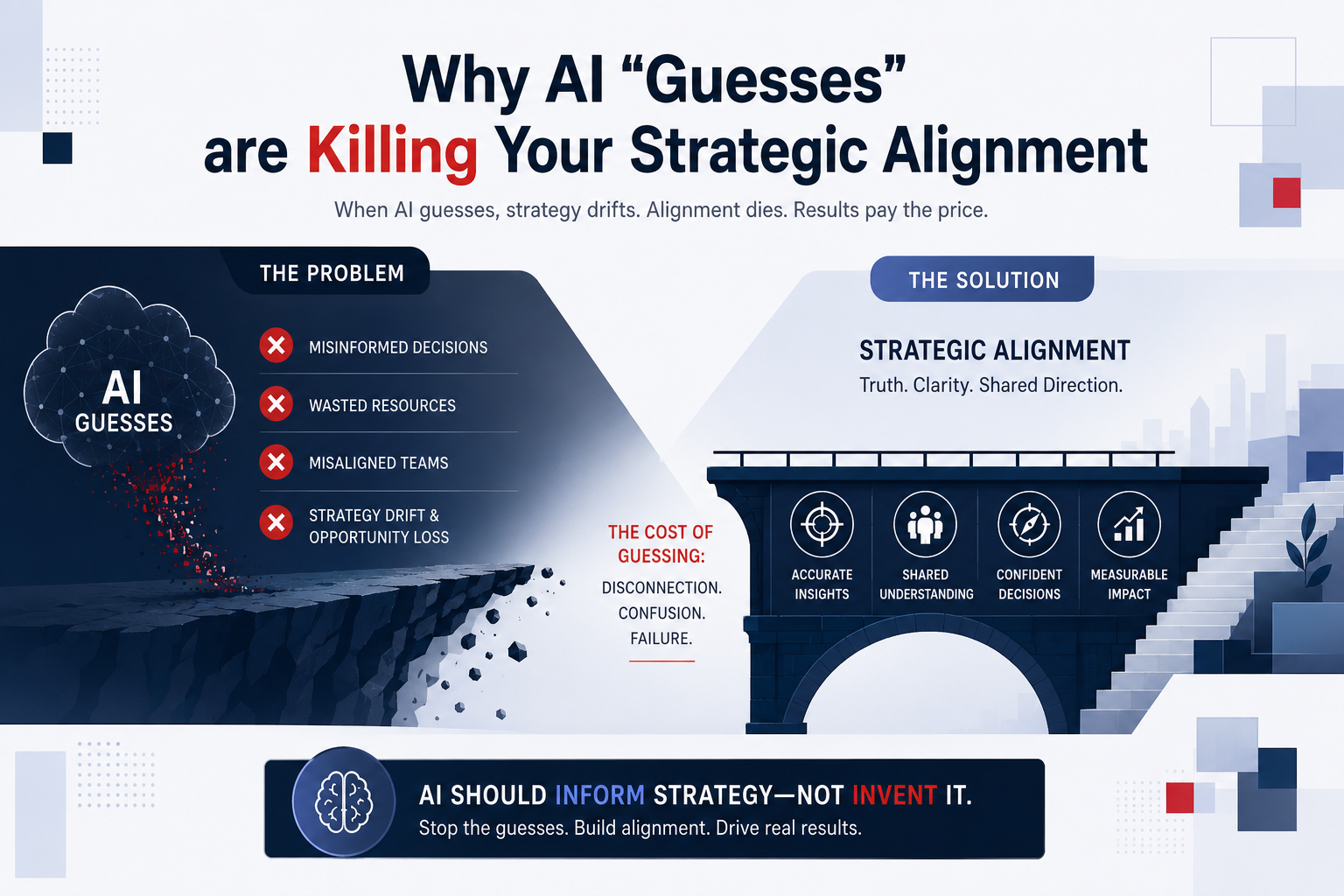
When two executives ask AI the same strategic question and receive different answers, they’re not getting personalized insights. They’re creating divergent strategies. Left unchecked, AI doesn’t just accelerate decision making, it accelerates misalignment.
If your organization isn’t intentionally enabling AI with shared context, governance, and strategic priorities, you’re not building a competitive advantage. You’re making critical business decisions on an unstable foundation, increasing the risk that teams move faster in different directions instead of toward the same destination.
The Hidden Cost of “The Guess”
Large Language Models are designed to be helpful, which means they hate to say “I don’t know.” When an AI lacks clear context or data, it fills those gaps with its own patterns, your past writing style, and even your hidden biases.
The result? Confidence without Accuracy. The output looks polished and professional, so leadership treats it as fact, but the underlying logic is a guess based on personalized history rather than company-wide reality.
The Three Pillars of LANDSA AI Enablement
To move from “accidental accuracy” to “intentional impact,” you need three specific structural shifts:
- Contextual Guardrails over Generic Prompts Most teams “chat” with AI. High-performing teams “engineer” context. We focus on building guardrails that ensure the AI understands your specific industry standards, financial targets, and cultural nuances before it ever generates a single word of advice.
- Repeatable Workflows (The “Anti-Noise” Strategy) Consistency is the byproduct of structure. If your process for vetting a new market or analyzing a P&L involves a human “winging it” with a prompt, your results will be inconsistent. Enablement means creating repeatable, vetted workflows where the AI is fed the same high-quality data every time.
- The “Validation” Layer AI enablement isn’t just about using the tool; it’s about training your team to be the “Master” in the room. Just like the martial arts example I shared where a small correction in angle makes the break your team needs to know exactly where to strike. They must be able to spot when an AI is “guessing” and have the technical literacy to pull it back to the truth.
The Bottom Line
AI is accelerating everything—the pace, the pressure, and the feeling that you need answers now. But speed without alignment is just a faster way to end up in the wrong place.
Don’t let your AI guess what you mean. Build a system where accuracy is a deliverable, not a lucky break.
Stop optimizing on top of noise. Visit LANDSA.co to see how we help leaders bridge the gap between AI potential and realized profit.